Bits/Bytes
Blocks that handle integers at the bit and byte level. Every input value is automatically converted to a 4-byte (32-bit) integer; bit and byte positions count from 0, and position 0 is the LSB (Least Significant Bit/Byte). In the lists produced by the decompose blocks and accepted by the combine blocks, the first item is the LSB; items of a bit list are [Digital] and items of a byte or word list are [Number]. Connect a Create List With block to a combine block to supply its items.
Bitwise AND / OR / XOR
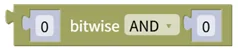
Performs a bitwise AND, OR, or exclusive OR (XOR) on two input values. The input values are automatically converted to integers.
- Input: value1 [Number], value2 [Number]
- Output: calculated value [Number]
Bitwise NOT
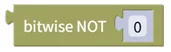
Inverts every bit of the input value (NOT). The input value is automatically converted to an integer.
- Input: value [Number]
- Output: calculated value [Number]
Bit Shift / Rotate

Shifts (shift) or rotates (rotate) the bits of the input value left or right by the specified number of bits. The input value is automatically converted to an integer.
- Input: value [Number], number of bits to shift or rotate [Number]
- Output: result value [Number]
Toggle Bits

Toggles n bits starting at the specified bit position (true ↔ false). The input value is automatically converted to a 4-byte (32-bit) integer; positions start at 0, and position 0 is the LSB.
- Input: value [Number], start position [Number], count to toggle [Number]
- Output: calculated value [Number]
Count True Bits
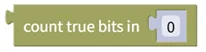
Counts the bits that are true (1) in the input value. The input value is automatically converted to a 4-byte (32-bit) integer.
- Input: value [Number]
- Output: number of true bits [Number]
Decompose to Bit List
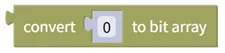
Decomposes the input value into a list of bits. The input value is automatically converted to a 4-byte (32-bit) integer, and the first item of the list is the LSB. Example: decimal 123 → binary 01111011 → [true, true, false, true, true, true, true, false]
- Input: value [Number]
- Output: decomposed bits [List]
Decompose to Byte List
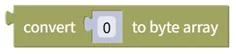
Decomposes the input value into a list of bytes. The input value is automatically converted to a 4-byte integer, and the first item of the list is the LSB (Least Significant Byte).
- Input: value [Number]
- Output: decomposed bytes [List]
Decompose to Word (2-byte) List
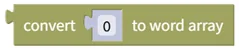
Decomposes the input value into a list of 2-byte words. The input value is automatically converted to a 4-byte integer, and the first item of the list is the least significant word.
- Input: value [Number]
- Output: decomposed words [List]
Combine Bit List
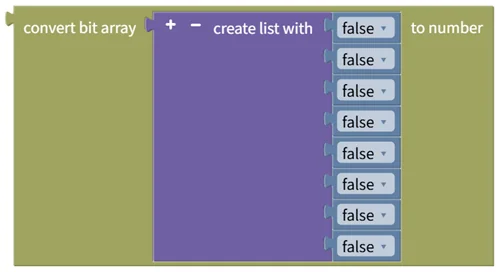
Combines a list of bits into a 4-byte (32-bit) integer. The first item of the list is the LSB. Example: [true, true, false, true, true, true, true, false] → binary 01111011 → decimal 123
- Input: bit list [List]
- Output: combined integer value [Number]
Combine Byte List
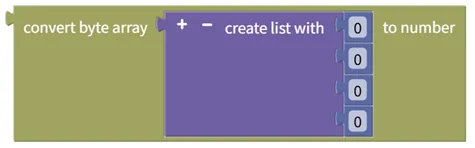
Combines a list of bytes into a 4-byte integer. The first item of the list is the LSB (Least Significant Byte).
- Input: byte list [List]
- Output: combined integer value [Number]
Combine Word (2-byte) List

Combines a list of 2-byte words into a 4-byte integer. The first item of the list is the least significant word.
- Input: word list [List]
- Output: combined integer value [Number]
Extract Bits

Extracts n bits starting at the specified bit position and returns them as a number. The input value is automatically converted to a 4-byte (32-bit) integer; positions start at 0, and position 0 is the LSB.
- Input: value [Number], position [Number], count [Number]
- Output: extracted value [Number]
Extract Bytes

Extracts n bytes starting at the specified byte position and returns them as a number. The input value is automatically converted to a 4-byte integer; positions start at 0, and position 0 is the LSB (Least Significant Byte).
- Input: value [Number], position [Number], count [Number]
- Output: extracted value [Number]
Reverse Bit Order

Reverses the order of the specified number of bits starting at the specified bit position. The input value is automatically converted to a 4-byte (32-bit) integer; positions start at 0, and position 0 is the LSB.
- Input: value [Number], position [Number], count [Number]
- Output: calculated value [Number]
Reverse Byte Order

Reverses the order of the specified number of bytes starting at the specified byte position. The input value is automatically converted to a 4-byte integer; positions start at 0, and position 0 is the LSB (Least Significant Byte).
- Input: value [Number], position [Number], count [Number]
- Output: calculated value [Number]
Reverse Word (2-byte) Order

Swaps the high and low 2-byte words of the input value. The input value is automatically converted to a 4-byte integer.
- Input: value [Number]
- Output: calculated value [Number]
Set Bits

Sets n bits starting at the specified bit position to true or false. The input value is automatically converted to a 4-byte (32-bit) integer; positions start at 0, and position 0 is the LSB.
- Input: value [Number], position [Number], count [Number], value [Digital]
- Output: calculated value [Number]
Set Bytes

Sets n bytes starting at the specified byte position to a value in the range 0-255. The input value is automatically converted to a 4-byte integer; positions start at 0, and position 0 is the LSB (Least Significant Byte).
- Input: value [Number], position [Number], count [Number], value [Number]
- Output: calculated value [Number]
Convert Decimal to BCD List

Converts a decimal input value to a BCD (Binary Coded Decimal) list.
- Input: value [Number]
- Output: converted BCD list [List]
Convert BCD List to Decimal
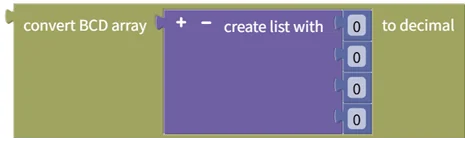
Converts a BCD list to a decimal number.
- Input: BCD list [List]
- Output: converted value [Number]