Math
Arithmetic and mathematical functions. For angles, only the inputs of the trigonometric functions (sin, cos, tan) are in degrees; the outputs of the inverse trigonometric functions, the hyperbolic functions, and coordinate conversion are in radians. The Split Decimal block and the Coordinate Conversion block return their two results as a [List].
Number

Outputs a numeric constant. Enter the value directly in the block's field.
- Input: none
- Output: value [Number]
Constants

Returns one of the mathematical constants π (3.141…), e (2.718…), φ (1.618…), sqrt(2) (1.414…), sqrt(1/2) (0.707…), or ∞ (infinity).
- Input: none
- Output: constant value [Number]
Arithmetic

Calculates the sum, difference, product, quotient, or power of two numbers.
- Input: value1 [Number], value2 [Number]
- Output: calculated value [Number]
Remainder
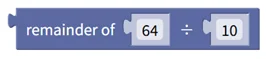
Returns the remainder from dividing the two input values.
- Input: value1 [Number], value2 [Number]
- Output: remainder [Number]
Round

Rounds a number at the specified number of decimal places with round, round up, or round down. Example: round 1.234 to 1 decimal place → 1.2
- Input: number [Number], decimal places [Number]
- Output: rounded number [Number]
Split Decimal

Separates a number into its integer part and fractional part and returns them as a list. Example: 1.234 → [1, 0.234]
- Input: number [Number]
- Output: [integer part, fractional part] [List]
Square Root, Absolute Value, Logarithm, Exponentiation
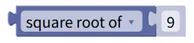
Calculates one of the square root, absolute value, negation, natural logarithm (ln), common logarithm (log), e to the power (e^), or 10 to the power (10^) of the input value.
- Input: value [Number]
- Output: calculated value [Number]
nth Root
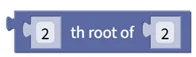
Calculates the nth root of a number. n = 2 is the square root and n = 3 the cube root. Example: 3rd root of 8 → 2
- Input: base number [Number], root index [Number]
- Output: nth root [Number]
Reciprocal
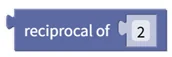
Calculates the reciprocal (1 divided by the number). Example: reciprocal of 4 → 0.25
- Input: number [Number]
- Output: reciprocal [Number]
Trigonometric Functions
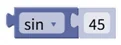
Calculates sin, cos, tan, asin, acos, or atan. The input unit for sin, cos, and tan is degrees; the output unit for asin, acos, and atan is radians.
- Input: angle [Number]
- Output: trigonometric function value [Number]
Hyperbolic Functions
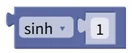
Calculates the hyperbolic sine (sinh), hyperbolic cosine (cosh), or hyperbolic tangent (tanh). The input is in radians.
- Input: angle [Number]
- Output: hyperbolic function value [Number]
Constrain

Constrains the input value to between the minimum and maximum values. Example: constrain 105 to minimum 1, maximum 100 → 100
- Input: input value [Number], minimum value [Number], maximum value [Number]
- Output: constrained value [Number]
Random Integer

Returns a random integer between the minimum and maximum values, inclusive.
- Input: minimum value [Number], maximum value [Number]
- Output: random integer [Number]
Random Fraction
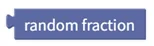
Returns a random fraction from 0.0 (inclusive) up to 1.0 (exclusive).
- Input: none
- Output: random fraction [Number]
Number Properties
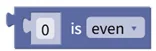
Checks whether the input value is even, odd, prime, whole, positive, or negative, or whether it is divisible by a given number.
- Input: value [Number]
- Output: property match [Digital]
Range Check
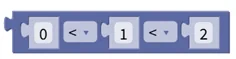
Checks whether a value falls within the specified range. Choose the inequality operators to control whether the boundaries are included.
- Input: minimum value [Number], test value [Number], maximum value [Number]
- Output: within range [Digital]
Linear Scale
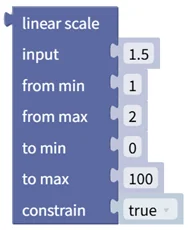
Maps an input value from one range to another with a linear transformation. If constrain is true, the output is clamped to the output range. Example: map 3 from [0, 10] to [0, 100] → 30
- Input: input [Number], from min [Number], from max [Number], to min [Number], to max [Number], constrain [Digital]
- Output: mapped value [Number]
Coordinate Conversion
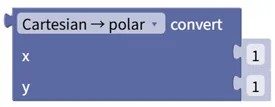
Converts between Cartesian coordinates (x, y) and polar coordinates (radius, angle). The angle is in radians.
- Input: coordinate1 [Number], coordinate2 [Number]
- Output: converted coordinates [List]
List Operations
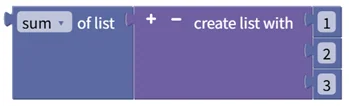
Calculates one of the sum, minimum, maximum, average, median, mode, standard deviation, or a random item of the numbers in a list.
- Input: list [List]
- Output: calculated value [Number]