Science
Calculates sun and moon rise/set times, azimuth, and altitude, psychrometric (moist air) properties, standard atmospheric pressure, and sea level pressure correction. The output item is selected from the block's dropdown, and the output type is a time or a number depending on the selection. Latitude and longitude are in degrees (°), altitude in meters (m), temperature in Celsius (°C), and pressure in Pascals (Pa).
Sun Rise/Set/Noon Time, Azimuth, Altitude
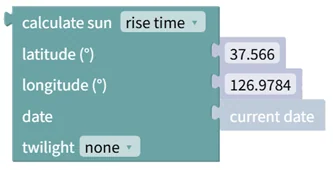
Calculates one of the sun's rise time, set time, noon time (sunrise, sunset, and solar noon: the times on a given date when the sun rises, sets, and reaches its highest point), azimuth (its horizontal direction angle at a given time), or altitude (its vertical angle at a given time). The twilight option is none, civil, nautical, or astronomical.
- Input: latitude (°) [Number], longitude (°) [Number], date [Date], time [Time]
- Output: time [Time] or angle [Number]
Moon Rise/Set/Noon Time, Azimuth, Altitude, Phase
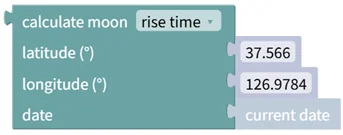
Calculates one of the moon's rise time, set time, noon time (moonrise, moonset, and lunar noon: the times on a given date when the moon rises, sets, and reaches its highest point), azimuth (its horizontal direction angle at a given time), altitude (its vertical angle at a given time), or phase. The phase expresses the moon's shape as a number on a scale of 0 (new moon), 0.5 (half moon), and 1 (full moon).
- Input: latitude (°) [Number], longitude (°) [Number], date [Date], time [Time]
- Output: time [Time] or angle/phase value [Number]
Air Humidity/Temperature Properties Calculation
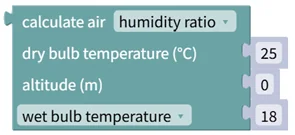
Calculates the properties of moist air. The 13 calculable properties are humidity ratio, wet bulb temperature, dew point temperature, relative humidity, vapor pressure, enthalpy, specific volume, density, degree of saturation, saturation vapor pressure, vapor pressure deficit, absolute humidity, and humidity deficit. The input conditions are the dry bulb temperature and altitude plus one of wet bulb temperature, dew point temperature, or relative humidity, selected from the dropdown.
- Input: dry bulb temperature (°C) [Number], altitude (m) [Number], wet bulb temperature or dew point temperature or relative humidity [Number]
- Output: calculated air property value [Number]
Standard Atmospheric Pressure/Temperature at Altitude
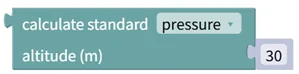
Calculates the standard pressure or temperature at a specific altitude using the International Standard Atmosphere (ISA) model. Example: altitude 1000 m → standard pressure 89,875 Pa, standard temperature 8.5°C
- Input: altitude (m) [Number]
- Output: standard pressure (Pa) or standard temperature (°C) [Number]
Station Pressure and Sea Level Pressure Conversion
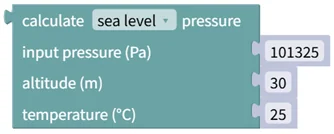
Converts between station pressure and sea level pressure. With sea level pressure selected, returns the pressure measured at a specific altitude corrected to sea level; with station pressure selected, returns the sea level pressure converted to the actual atmospheric pressure at a specific altitude. Used in meteorological observation to correct for pressure differences caused by altitude.
- Input: pressure (Pa) [Number], altitude (m) [Number], temperature (°C) [Number]
- Output: converted pressure (Pa) [Number]