Complex/Vector
Complex number and 3D vector operations. Complex numbers and 3D vectors are separate data types: create a value with the Create Complex Number or Create 3D Vector block and connect it to the inputs of the other blocks. The argument and the angle between vectors are in radians (rad).
Create Complex Number
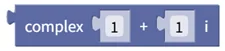
Creates a complex number from a real part and an imaginary part. Example: 3 + 4i
- Input: real part [Number], imaginary part [Number]
- Output: complex number [Complex Number]
Extract Real/Imaginary Part

Extracts the real or imaginary part of a complex number. Example: real part of (3 + 4i) → 3
- Input: complex number [Complex Number]
- Output: real or imaginary part [Number]
Absolute Value

Calculates the absolute value (magnitude) of a complex number. Example: |3 + 4i| → 5
- Input: complex number [Complex Number]
- Output: absolute value [Number]
Norm

Calculates the norm (squared magnitude) of a complex number. Example: norm(3 + 4i) → 25
- Input: complex number [Complex Number]
- Output: norm [Number]
Complex Conjugate

Calculates the complex conjugate. The sign of the imaginary part is reversed. Example: conj(3 + 4i) → 3 - 4i
- Input: complex number [Complex Number]
- Output: complex conjugate [Complex Number]
Compare Complex Numbers

Tests whether two complex numbers are equal. Both the real and imaginary parts must be equal to return true.
- Input: complex number1 [Complex Number], complex number2 [Complex Number]
- Output: equality status [Digital]
Complex Number Argument

Calculates the argument (phase angle) of a complex number in radians: the angle from the positive real axis in the complex plane.
- Input: complex number [Complex Number]
- Output: argument [Number]
Create Complex Number from Polar Form

Creates a complex number from polar form (magnitude and argument). Magnitude r, argument θ → r(cos θ + i sin θ). The argument is in radians.
- Input: magnitude [Number], argument [Number]
- Output: complex number [Complex Number]
Complex Number Arithmetic

Calculates the sum, difference, product, or quotient of two complex numbers.
- Input: complex number1 [Complex Number], complex number2 [Complex Number]
- Output: operation result [Complex Number]
Complex Trigonometric Functions
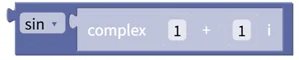
Calculates one of the trigonometric functions sin, cos, tan or the hyperbolic functions sinh, cosh, tanh of a complex number.
- Input: complex number [Complex Number]
- Output: trigonometric function result [Complex Number]
Complex Transcendental Functions

Calculates one of the exponential (e^), natural logarithm (ln), common logarithm (log₁₀), or square root (√) of a complex number.
- Input: complex number [Complex Number]
- Output: transcendental function result [Complex Number]
Complex Number Exponentiation

Raises a complex number to a power. Both the base and the exponent are complex numbers.
- Input: base [Complex Number], exponent [Complex Number]
- Output: exponentiation result [Complex Number]
Complex Number Inverse

Calculates the additive inverse (-z) or the multiplicative inverse (1/z) of a complex number.
- Input: complex number [Complex Number]
- Output: inverse [Complex Number]
Create 3D Vector
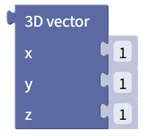
Creates a 3D vector from x, y, and z components.
- Input: x [Number], y [Number], z [Number]
- Output: vector [3D Vector]
Extract Vector Components
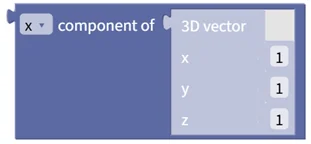
Gets the selected x, y, or z component of a 3D vector.
- Input: vector [3D Vector]
- Output: x, y, or z component of the vector [Number]
Vector Magnitude
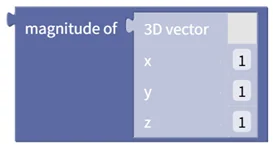
Gets the magnitude (length) of a 3D vector.
- Input: vector [3D Vector]
- Output: vector magnitude [Number]
Unit Vector
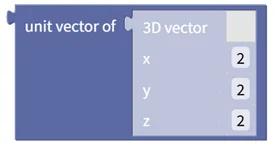
Gets the unit vector of a 3D vector: the vector with the same direction and a magnitude of 1.
- Input: vector [3D Vector]
- Output: unit vector [3D Vector]
Check Zero Vector
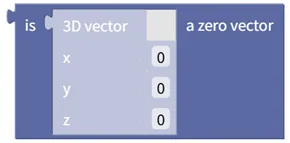
Returns true if all components of the 3D vector are 0, false otherwise.
- Input: vector [3D Vector]
- Output: zero vector status [Digital]
Reverse Vector
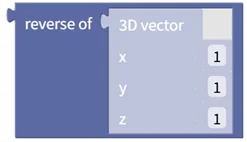
Gets the vector pointing in the opposite direction of the 3D vector.
- Input: vector [3D Vector]
- Output: reversed vector [3D Vector]
Vector Addition/Subtraction
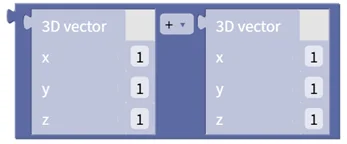
Adds or subtracts two 3D vectors.
- Input: vector1 [3D Vector], vector2 [3D Vector]
- Output: calculated vector [3D Vector]
Angle Between Vectors
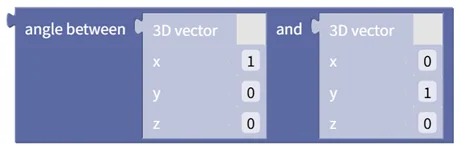
Gets the angle between two 3D vectors. The angle is in radians (rad).
- Input: vector1 [3D Vector], vector2 [3D Vector]
- Output: angle between the two vectors [Number]
Check Vector Parallelism
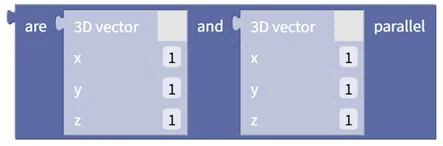
Returns true if two 3D vectors are parallel, false otherwise.
- Input: vector1 [3D Vector], vector2 [3D Vector]
- Output: parallel status of the two vectors [Digital]
Angle Between Vector and Axis
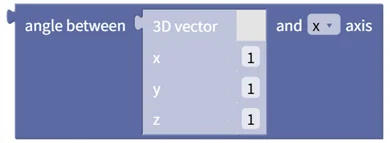
Gets the angle between a 3D vector and the selected x, y, or z axis.
- Input: vector [3D Vector]
- Output: angle between the vector and the selected axis [Number]
Vector Dot Product
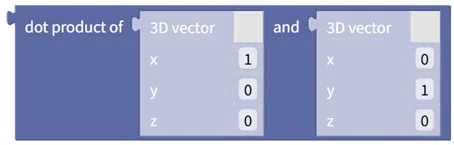
Gets the dot product (inner product) of two 3D vectors. The result is a number.
- Input: vector1 [3D Vector], vector2 [3D Vector]
- Output: dot product of the two vectors [Number]
Vector Cross Product
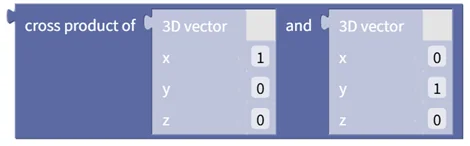
Gets the cross product of two 3D vectors. The result is a 3D vector.
- Input: vector1 [3D Vector], vector2 [3D Vector]
- Output: cross product of the two vectors [3D Vector]
Vector Scalar Multiplication
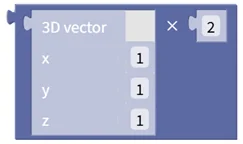
Multiplies a 3D vector by a scalar value.
- Input: vector [3D Vector], scale [Number]
- Output: calculated vector [3D Vector]